

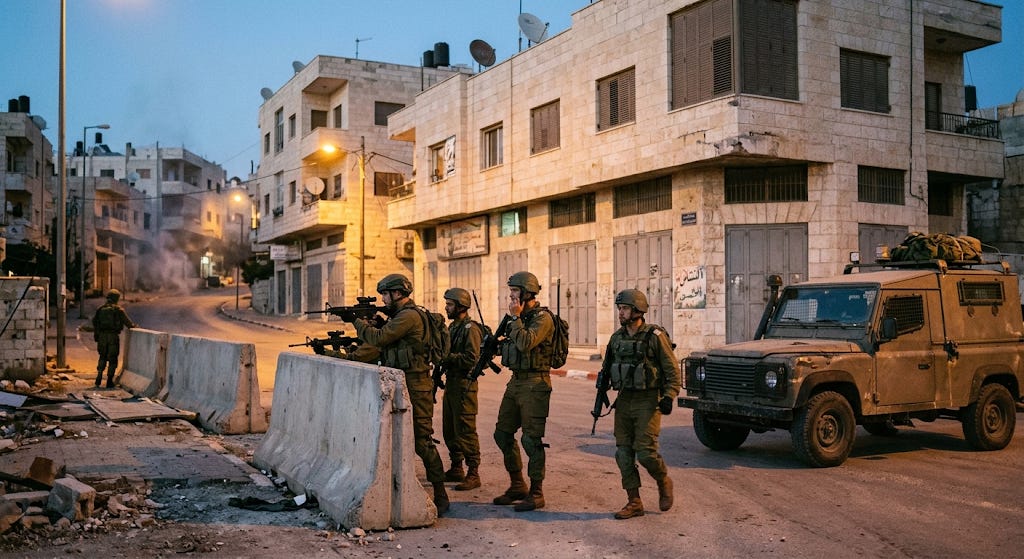
Since 21 January 2025, the Israeli army has been carrying out a large counter-terrorism operation in northern Judea and Samaria. The operation began focusing on Jenin, although it has since expanded to other Palestinian cities and towns, such as Tulkarem. The operation, known as “Iron Wall,” is one of the largest Israeli counter-operations in the area in years – the mayor of Jenin recently compared the operation to the fighting in Gaza. On February 24, 2025, Israeli tanks entered Judea and Samaria for the first time in twenty years. It has been suggested that Israel is barred from operating according to the more expansive Laws of Armed Conflict (LOAC) but is instead confined to the restrictive law enforcement paradigm.[1]
The claim that Israel must deal with armed Palestinian groups through the prism of law enforcement rests on the assumption that no armed conflict exists between them and Israel. The fighting has not risen to a necessary threshold of intensity, nor do these organizations possess the requisite command structure. Should this be the case, Israel would be prohibited from using lethal force against members of Palestinian armed groups except as a last resort.[2] This paper argues that an armed conflict exists between Israel and Palestinian armed groups. It demonstrates this by examining (1) the legal definitions of NIAC and IAC, (2) the organization and intensity of armed groups in Judea and Samaria, and (3) relevant case law and state practice.
Classifying Armed Conflicts
The existence of an armed conflict determines the applicable legal framework. The International Criminal Tribunal for the Former Yugoslavia (ICTY) in Prosecutor v. Tadić established that an armed conflict exists when there is “protracted armed violence between governmental authorities and organized armed groups or between such groups within a State”.[3] Similarly, the Inter-American Commission on Human Rights (IACHR) in Juan Carlos Abella v. Argentina defined Common Article 3 conflicts as involving “low-intensity and open armed confrontations between relatively organized armed forces or groups”.[4]
As is well known, LOAC traditionally distinguishes between international armed conflicts (IAC) and non-international armed conflicts (NIAC). The proper approach to hostilities between State parties and terrorist organizations has been the subject of much debate.
The Israeli Supreme Court has ruled in a series of decisions that the applicable legal framework to the conflict between Israel and Palestinian armed groups is that of IAC and not domestic law. In the Committee against Torture decision, the Supreme Court stated:
“The fact that terrorist organizations and their members do not act on behalf of a state does not render the struggle against them a purely internal armed conflict. Indeed, in today’s reality, a terrorist organization may possess significant military capabilities—sometimes even exceeding those of certain states. Addressing these threats cannot be confined solely to the state and its domestic criminal law. Confronting the threat of terrorism is part of international law, which governs armed conflicts of an international nature.”[5]
The Israeli Supreme Court relied, among others, on the positions of A. Cassese that “an armed conflict which takes place between an Occupying Power and rebel or insurgent groups – whether or not they are terrorist in character – in an occupied territory, amounts to an international armed conflict”.[6] Dinstein holds that, if insurgents obtain from the de facto Occupying government “recognition of belligerency”, the armed conflict will be an IAC.[7] Israeli Defense Minister recently labeled a deadly Palestinian terror attack an “act of war”, underscoring Israel’s recognition of the armed group’s enemy status.
Following the September 11th terrorist attacks, the United States adopted the position that the conflict with al-Qaeda (as opposed to that with the Taliban) was a non-international armed conflict, albeit with a transnational character, as international law referred to intra-state conflict. This approach was reinforced in the US Supreme Court Hamdan v. Rumsfeld decision.[8] Given that NIACs require a high level of organization and intensity, the next section assesses whether groups operating in Judea and Samaria meet these criteria.
Organization
It should be stressed that a distinction between the conflict in Gaza and that in Judea and Samaria is arbitrary and artificial. Hamas intended its October 7th attack to provoke a wider conflict in Judea and Samaria and Israel proper. The terrorist groups operating in Judea and Samaria are branches of those groups that Israel is fighting in Gaza. Hamas and other groups have officials and resources dedicated to terrorism in Judea and Samaria (like the late Salah Arouri).
Certain authorities, such as the International Law Association (the ILA) and the ICRC, have rejected the concept of an armed conflict against a terrorist organization. According to the ICRC’s Vité, “al-Qaeda is a “loosely connected, clandestine network of cells . . . [t]hese cells do not meet the organization criterion for . . . a non-international armed conflict.”[9] The ILA and ICRC rely extensively on the so-called “Tadic Criteria” in ICTY jurisprudence, namely a sufficient level of organization and hostilities of significant intensity.[10] Despite these reservations, state practice developed over two decades of American hostilities against al-Qaeda and ISIS seems to firmly support the existence of NIAC against terrorist organizations. In contrast to al-Qaeda’s loose network of cells, the Jenin Brigades – composed of various Palestinian terrorist groups such as Hamas and Palestinian Islamic Jihad (PIJ) – act as armed battalions of gunmen.[11]
According to the ICRC’s 1952 Commentary, several conditions may indicate the existence of an armed conflict with an armed group. Some relevant criteria are that the armed group possesses an organized military force, that the legal government was obligated to use military forces against the insurgents, or that the government has recognized insurgents as belligerents.[12]
As previously mentioned, the Jenin Brigades, Hamas, PIJ, and the Lions’ Den function as organized militias similar to conventional forces, as opposed to small terrorist cells. These groups are themselves branches of the terrorist groups in Gaza that carried out the October 7th massacre. The rising violence in Judea and Samaria, beginning in October 2022, was spearheaded by PIJ, and the various groups operating in the area openly acknowledge their PIJ affiliation. One of the most violent groups, the Jenin Brigade, was founded by PIJ militant Jamil al-Amuri in 2021. Other armed groups are coordinated by the al-Aqsa Martyrs Brigade, which is affiliated with the Fatah party and acts in tandem with the PIJ. According to Armed Conflict Location and Event Data (ACLED), Hamas’ forces in Judea and Samaria focus on high-impact operations and attacks on settlers, as opposed to more numerous smaller attacks.[13]
In any case, “decentralization does not mean that groups do not meet the international humanitarian law requirement of an organization”.[14] In Prosecutor v. Limaj, the ICTY held that “some degree of organization by the parties will suffice to establish the existence of an armed conflict.[15] Certainly, armed Palestinian terrorist groups meet these basic requirements.
Intensity
As mentioned, the existence of an NIAC can be determined by reaching a certain intensity threshold of violence. According to the 2008 Prosecutor v. Boskoski decision, “while isolated acts of terrorism may not reach the threshold of armed conflict, when there is protracted violence of this type, especially where they require the engagement of the armed forces in hostilities, such acts are relevant to assessing the level of intensity with regard to the existence of an armed conflict”.[16]
According to annual data released by the Israeli Shabak (Security Forces), in 2024 it successfully foiled over 1,000 terrorist attacks in Judea, Samaria and Jerusalem. These include close to 700 shooting attacks and 300 explosive devices. Furthermore, Palestinian terrorist groups successfully carried out 231 terrorist attacks. 2023 also featured over 1000 thwarted attacks and 400 successful ones. This contrasts with 470 attempts in 2022 and 350 in 2021.[17] These numbers demonstrate a sharp rise in the intensity of the conflict with Palestinian terrorist groups over a two-year period. Only last month, two elderly Israeli women and a police officer were killed, and another eight wounded when Palestinian terrorists opened fire against cars driving by the village of al-Funduq. In mid-February, three empty buses exploded in southern Tel Aviv in an attack originating in cells based in Tulkarem. This flare-up comes as Iran steps up its smuggling operations of advanced weapons to Palestinian terror groups, intending to open another front against Israel.[18]
It should be noted that the Inter-American Commission on Human Rights in the La Tablada case held that an attack by 42 armed persons against a military barracks, resulting in 30 hours of combat, was sufficient to cross the intensity threshold for a NIAC.[19] The protracted Palestinian terror campaign against civilians and military in Judea, Samaria and Israel proper must certainly meet this threshold.
Challenges to the Law Enforcement Paradigm
Opponents of the LOAC classification argue that a law enforcement paradigm should govern Israel’s use of force, as many terrorist acts resemble criminal offenses rather than acts of war. However, international jurisprudence does not support this claim in the context of an occupied territory.
The U.S. Department of Defense Law of War Manual states that states are not required to apply LOAC when responding to ordinary crimes, including acts of terrorism. However, when terrorist threats surpass the capability of law enforcement, states may resort to military force, subject to jus in bello restrictions.[20] Historical precedents, such as the U.S. strikes on terrorist targets in Afghanistan (Clinton, 1998), illustrate that states do not rely solely on law enforcement when national security is at stake.
A key argument for applying the law enforcement paradigm is the claim that Israel exercises effective control over Judea and Samaria and, therefore, should be held to law enforcement standards in its use of force. However, this claim fails to consider the fragmented nature of Israeli control and the reality of ongoing hostilities. While Israel maintains security control over Area C and coordinates with the Palestinian Authority in other areas, it does not exercise full control over the entire territory. The presence of armed Palestinian factions, ongoing violent clashes, and the inability of Israeli forces to operate freely in certain areas challenge the notion of comprehensive, effective control.
Moreover, the law enforcement paradigm assumes a stable governance structure that maintains public order, a condition not present in Judea and Samaria. The Oslo Accords created a divided governance system in which the Palestinian Authority has jurisdiction over civilian matters in Area A and over civilian and security matters in Area B. At the same time, militias exert de facto control over certain areas. In such a fragmented legal and political landscape, expecting Israel to apply traditional law enforcement measures against highly organized militant groups engaged in sustained hostilities is unrealistic. The situation more closely resembles a protracted armed conflict rather than routine policing.
Recent Developments
Israeli security operations in Judea and Samaria have continued through 2026. On the night of 18–19 August 2026, Israeli forces carried out a wave of raids across Judea and Samaria, arresting at least thirty Palestinians according to the Palestinian Prisoners’ Club, while Israeli police separately detained the Palestinian Authority’s Minister for Jerusalem Affairs, Ashraf al-Ajouri, at his home in Silwan following a search. Additional arrests were reported in the Hebron area (a-Dhahiriya), Tulkarem (Deir al-Ghusun and surrounding areas), Qalqilya (Azzun), and the Jerusalem area (Qalandia refugee camp and Beit Duqqu).[21] The continuation of large-scale security operations across Judea and Samaria – encompassing both combat-oriented actions against armed groups and broader detention operations – illustrates the protracted and evolving nature of the conflict discussed above, and reinforces the argument that a law enforcement paradigm alone does not capture the scope of Israel’s security activity in the area.
Conclusion
An armed conflict exists between Israel and armed Palestinian terrorist groups in Judea and Samaria. The Israeli Supreme Court has traditionally characterized this conflict as an IAC. By contrast, the United States and most others consider conflicts between a state and an armed group as an NIAC. The armed Palestinian groups in Judea and Samaria function similarly to conventional militaries and have a basic level of organization and hierarchy. The armed groups in Judea and Samaria are affiliates of Hamas, Palestinian Islamic Jihad, and the al-Aqsa Martyrs Brigade, groups that Israel is at war with in Gaza. Furthermore, high levels of hostilities in the region have been ongoing for at least two years, with over 1,000 foiled and successful terrorist attacks against Israeli civilians and the military, and security operations – including the large-scale raids of August 2026 – continuing into the present. The law enforcement paradigm does not recognize the complexity of the situation or allow Israel to adequately combat the terrorist threat.